
For most of the world, Indonesia means Bali. And Bali is genuinely deserving of its reputation as one of the great places on earth to slow down, breathe differently, and build a life that feels meaningful. But Indonesia is also 17,000 islands, several of which deserve serious attention from anyone considering a retirement that involves more than a beachside villa and a decent restaurant scene.
What draws people to Indonesia is harder to articulate than a list of practical advantages, but it is consistently reported by the people who move here. It is something about the depth of the culture, the warmth of the people, the extraordinary natural environment, and a spiritual texture to daily life, particularly in Bali, that gets under the skin in a way that surprises even seasoned travellers. Retirees who have spent time across the region frequently describe Indonesia as the place that felt most alive.
This guide covers what you actually need to know before making the move: the visa options, what things cost, the property rules, how to think about healthcare honestly, what daily life actually involves, and a destination-by-destination guide to the places where foreign retirees most commonly settle. Everything here reflects conditions as of 2026. Indonesia changes, sometimes quickly. Treat this as your starting framework and verify anything decision-critical with a qualified local adviser.
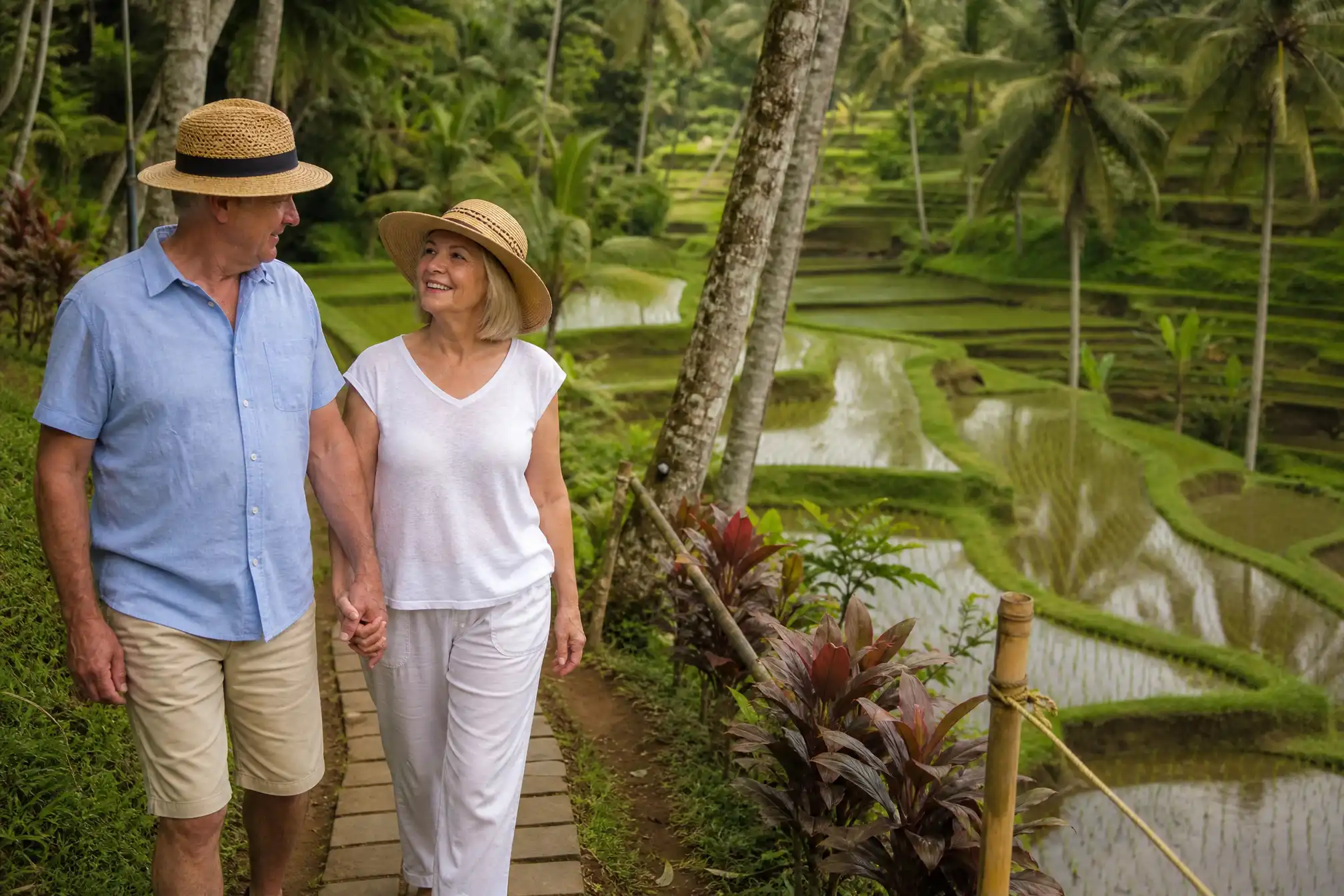
Use this guide as your starting point, then speak with us before committing to visas, property or healthcare arrangements.
Speak with our teamIndonesia offers a retirement experience that is genuinely distinct from anywhere else in the world. The natural environment is extraordinary, the culture is layered and alive in ways that reward long-term engagement, and the cost of living allows a quality of life that would be out of reach for most retirees in their home countries. It is not the easiest retirement destination to navigate, and that is worth knowing upfront. But for those who approach it with preparation and genuine curiosity, it consistently delivers something that more straightforward destinations do not.
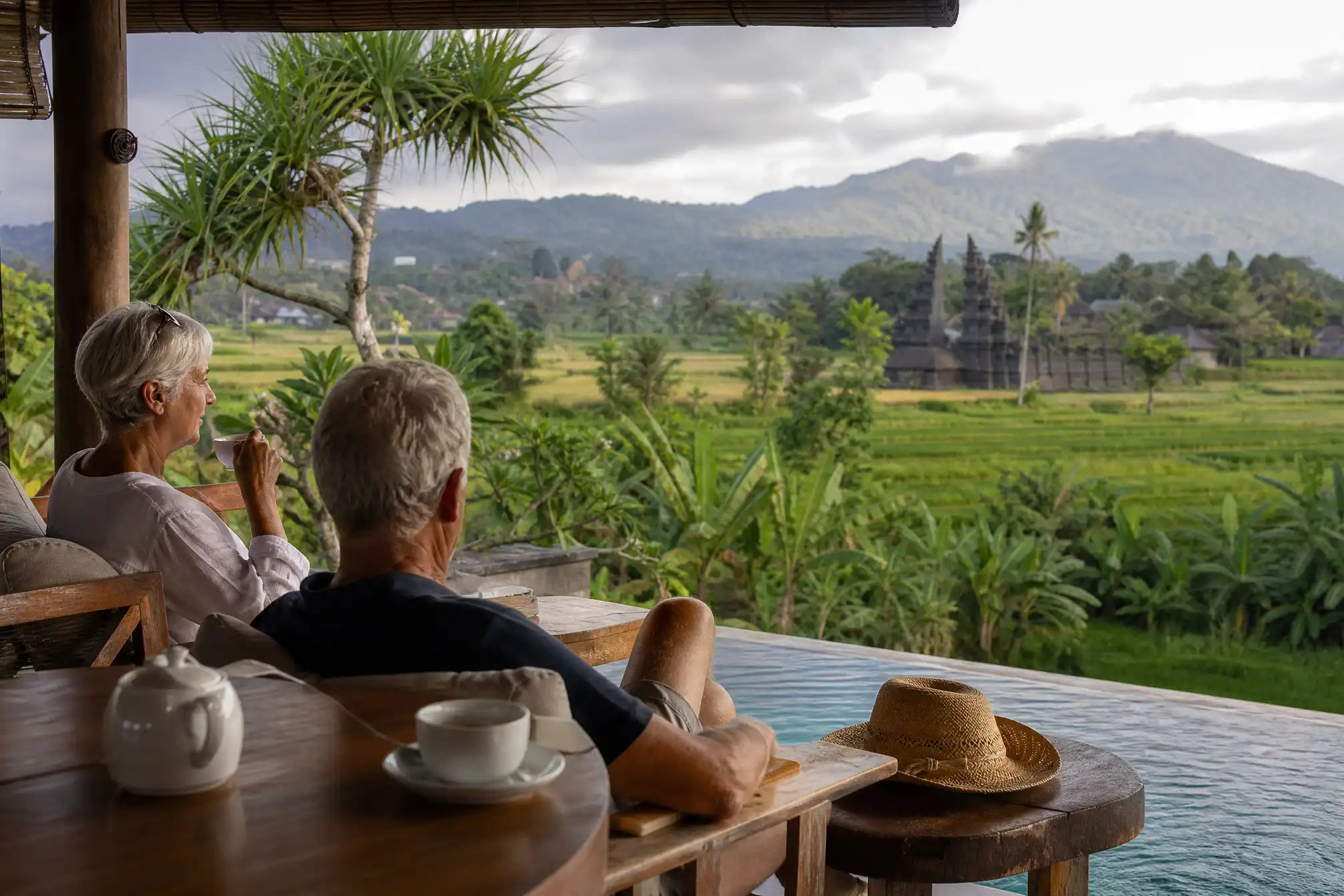
Indonesia can be coastal, cultural, rural, island-based or deeply community-oriented. The right fit depends on your health, budget and daily rhythm.
Explore your optionsIndonesia sits on the Pacific Ring of Fire and the result is a landscape of extraordinary drama: active volcanoes, including Mount Agung dominating Bali's skyline and Mount Rinjani on Lombok, rice terraces carved into hillsides over centuries, jungle rivers, coral reef systems among the most biodiverse in the world, and beaches that range from the famous surf breaks of Uluwatu to the utterly deserted white sand of the more remote islands. Living inside this environment rather than visiting it changes how the world feels in ways that are difficult to quantify but consistently described by the people who make the move.
Bali is the only Hindu-majority island in the world's largest Muslim-majority country, and the result is a culture that is uniquely layered and alive. Daily offerings, called canang sari, are placed at doorways, temples, and shrines every morning as an act of devotion and gratitude. Temple ceremonies happen throughout the year on a complex calendrical system, filling streets with processions, music, and elaborate costume. The Balinese gamelan is one of the great musical traditions of the world and can be heard in neighbourhood rehearsals on almost any evening. This is not heritage tourism. It is daily life, and living among it is a genuinely different experience from visiting it.
Indonesian culture is characterised by a concept called gotong royong, meaning mutual cooperation and communal effort, and by an emphasis on maintaining harmony and avoiding direct confrontation. For retirees from more transactional cultures, adjusting to this takes time. Most long-term expats describe it as one of the things they come to value most. The people of Bali and Lombok in particular are widely described by foreign residents as among the warmest and most genuinely hospitable in South-East Asia.
Living well in Indonesia is significantly cheaper than in most Western countries, but the gap has narrowed in Bali over the past five years. The post-COVID tourism surge and the digital nomad influx have driven prices up in the most popular south Bali neighbourhoods. A comfortable retirement lifestyle in Canggu or Seminyak costs noticeably more in 2026 than it did in 2019. It is still dramatically cheaper than comparable living in London, New York, or Sydney, but the Indonesia-of-bargains framing that older guides use requires updating.
Indonesia has real challenges worth understanding before you commit. The visa process is more administratively involved than most retirement destinations and requires a licensed local sponsor for the standard pathway. The property rules are strict and more dangerous to navigate without proper legal advice. Healthcare outside South Bali is genuinely limited. Corruption at a local government level exists and occasionally affects daily life. Infrastructure, while improving rapidly, is still inconsistent in some areas.
The retirees who thrive here are consistently those who arrived with clear eyes, invested in understanding the culture and language, built real relationships with Indonesian people rather than living exclusively within the expat bubble, and chose their specific location with genuine care. Indonesia rewards engagement, preparation, and a genuine desire to be here rather than just somewhere cheaper than home.
Indonesia's visa system for foreign retirees has two dedicated pathways, both updated in recent years. A licensed local sponsor or visa agency is a practical necessity for most applicants rather than an optional convenience. After five years on the standard retirement visa, a permanent stay permit becomes available.

Indonesia's retirement visa options are workable, but the sponsor, income, insurance and banking requirements need to be understood before you spend money.
Ask about visa supportThe standard retirement limited stay permit. Issued for one year, renewable annually for up to five consecutive years. Multiple-entry included. Available to retirees of most nationalities.
Introduced as part of Indonesia's Golden Visa framework. Valid for 5 years, renewable for a further 5 years. No local sponsor required. No domestic worker obligation. Multiple-entry included.
The permanent stay permit available after four consecutive years of holding a Retirement KITAS. Valid for five years and renewable indefinitely. The closest equivalent to permanent residency available to foreign retirees. You are legally allowed to purchase properties or invest in a retirement home once you hold a KITAP.
A spouse or financially dependent partner who does not independently qualify can apply for a Dependent KITAS tied to the primary holder's visa. Children under 18 can be included as dependants.
| Feature | E33F (Standard) | E33E (Silver Hair) |
|---|---|---|
| Minimum age | 55 | 60 |
| Initial validity | 1 year | 5 years |
| Maximum stay | 5 years (then KITAP eligible) | 10 years (extendable) |
| Income required | USD $3,000/month | USD $3,000/month |
| Bank deposit | Not required | USD $50,000 in state-owned bank |
| Local sponsor required | Yes | No |
| Domestic worker required | Yes | No |
We understand the visa process and conditions may seem confusing at first. However, it is relatively straightforward with the help of a good visa agent. Retire to Asia can provide you with a reputable visa agency that will make this process straightforward and manageable from start to finish.
Both the E33F and E33E come with a binding Statement of Non-Employment that is a condition of the visa. Working for pay in Indonesia on a retirement visa is classified as a criminal immigration violation under Indonesian law. This includes formal employment, freelancing, managing a local business, operating a villa rental, providing services for payment, and teaching or consulting. Violations typically result in deportation and a multi-year entry ban. If you intend to generate any income while in Indonesia, speak with a licensed immigration adviser about the appropriate visa structure well before you arrive.
Residing in Indonesia for more than 183 days in any 12-month period makes you an Indonesian tax resident, creating potential obligations on worldwide income. Indonesia has Double Taxation Agreements with a number of countries including the United Kingdom, Germany, France, the Netherlands, Japan, Singapore, and Australia, which in most cases prevents pension income taxed at source from being taxed again in Indonesia.
US citizens remain subject to US tax obligations globally under FATCA regardless of where they live and should seek specific advice. A qualified Indonesian tax adviser experienced with foreign residents is worth engaging in your first year.
Indonesia remains significantly cheaper than most Western countries, and the savings are real and meaningful. The important qualification is that Bali in 2026, particularly the south-west coast, is not the Bali of five or ten years ago. Prices have risen noticeably in the most popular expat areas since 2022, driven by a surge in short-stay visitors and the arrival of large numbers of digital nomads who drove up demand for accommodation, food, and services.
| City Comparison | Overall Cost Saving (Excl. Rent) |
|---|---|
| Bali vs New York | ~65% cheaper |
| Bali vs London | ~55% cheaper |
| Bali vs Sydney | ~57% cheaper |
| Bali vs Toronto | ~58% cheaper |
| Bali vs Amsterdam | ~52% cheaper |
| Bali vs Singapore | ~38% cheaper |
Source: Numbeo cost-of-living index comparisons, 2026. Figures are approximate. Individual outcomes vary based on lifestyle choices and specific location within Bali.
The table below compares common expense categories in Bali against Sydney as a Western baseline. US, UK, and European retirees will generally find the savings even larger than those shown here.
| Item | Bali (vs Sydney) |
|---|---|
| Consumer Prices (Overall) | -57% |
| Meal for 2 (3 Courses, Mid-Range) | -70% |
| Beer (Domestic, at Restaurant) | -70% |
| Coffee (Cappuccino) | -44% |
| Bottled Water | -72% |
| Groceries (Local Produce) | -47% |
| Local Transport (One-Way Ticket) | -94% |
| Utilities (Electricity / Water / Garbage) | -62% |
| Mobile Phone Plan (10GB+) | -72% |
| Internet (Unlimited Broadband) | -66% |
| Cinema Ticket | -80% |
| Rent (1BR, Town or Area Centre) | -57% |
Source: Numbeo Sydney vs Bali city comparison, May 2026. Savings vs New York and London are typically 8 to 15 percentage points larger than the Sydney figures shown. Lifestyle choices significantly affect actual outcomes.
Transport is the standout category. Getting around Bali by scooter or using GoJek for short trips costs a tiny fraction of equivalent Western costs. Local Indonesian food from warungs and markets is extraordinarily affordable. Mobile data, internet, and domestic services including household help and gardening are dramatically cheaper.
The savings narrow on imported goods, Western alcohol (beer is heavily taxed in Indonesia), international restaurant dining, and anything requiring import logistics to the island. Wine in particular is expensive relative to most countries due to high import duties. A lifestyle that embraces local food, local transport, and local services produces savings well above the averages shown.
If you have seen cost-of-living guides for Bali written before 2022, some figures will be materially out of date. Rental prices in Canggu and Seminyak have risen by 40 to 60% since 2020 driven by digital nomad demand and short-stay platform activity. Some mid-range restaurant prices in tourist-heavy areas are now closer to European levels than the bargain figures that earlier guides described.
Areas like Sanur, Ubud, and North Bali remain more affordable and have not experienced the same level of price inflation. If budget is a primary consideration, do a thorough current rental and cost survey in your target neighbourhood rather than relying on figures from guides written more than three years ago.
Indonesia's property rules for foreigners are more restrictive and more legally complex than those of most neighbouring countries, and the consequences of getting this wrong are serious. The foundation is simple: foreigners cannot own freehold land in Indonesia under any circumstances. There are three legally sound structures available, and one critically dangerous structure that is still widely used and must be avoided entirely.
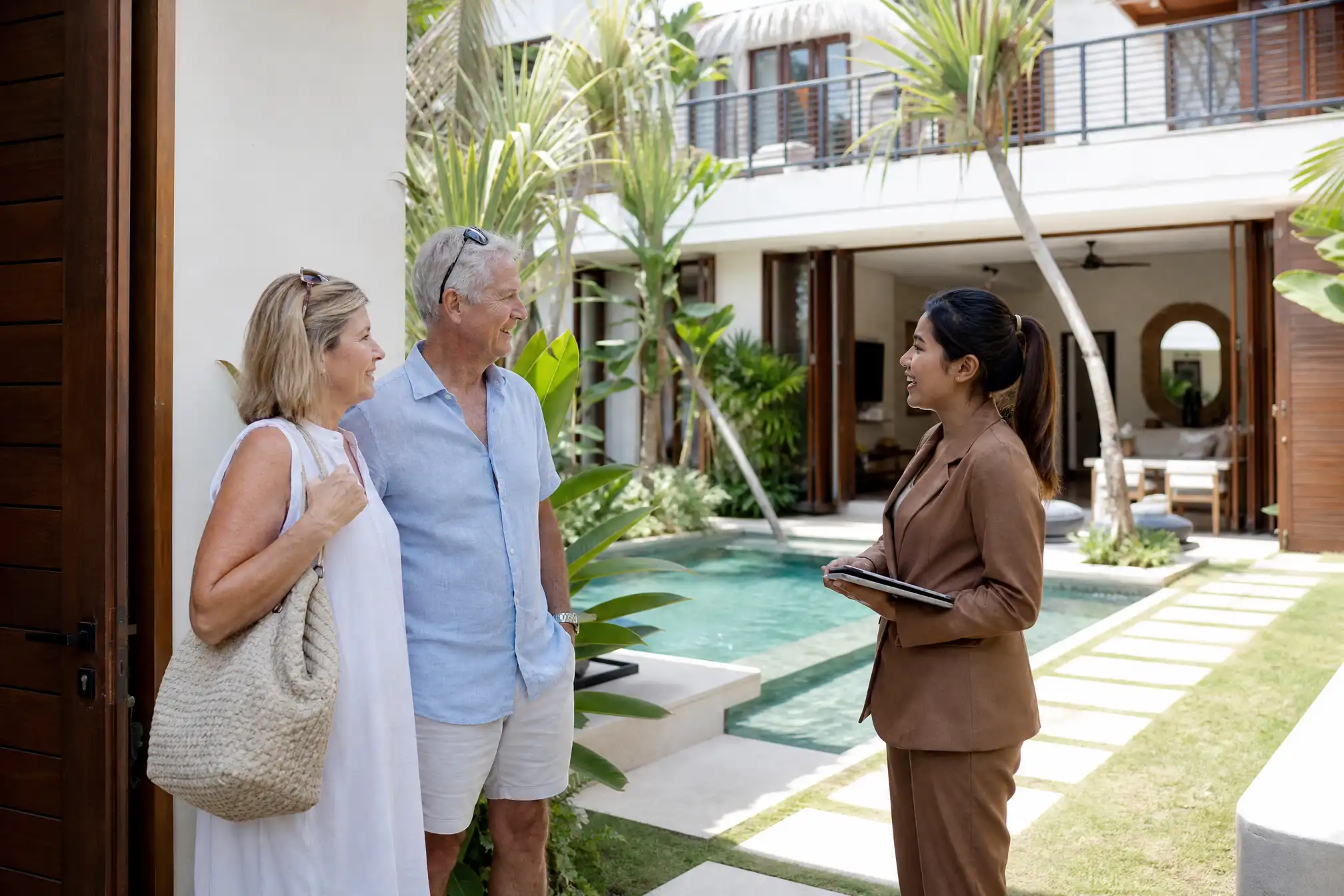
Foreigners cannot own freehold land in Indonesia. Leasehold, Hak Pakai and PT PMA structures need proper legal advice before signing.
Get property guidanceA Hak Sewa agreement gives you the right to use, occupy, and build on a property for a fixed period, typically 25 to 30 years, with extensions that can push total tenure to 80 years. The agreement is registered through a notary (PPAT) and is legally enforceable. Leasehold is the structure used by the large majority of foreign property buyers in Bali and Lombok.
The key practical consideration is depreciation: the remaining lease term gets shorter every year, and resale value declines accordingly. Negotiating clearly documented extension rights at the outset is important. Extension terms should be specific, not vague, and registered, not merely promised verbally or in marketing materials.
Hak Pakai is a registered land title issued in your own name, available to foreigners who hold a valid Indonesian residency permit (KITAS or KITAP). It provides stronger legal standing than a leasehold. The initial term is 30 years, extendable by 20 years, and renewable for a further 30, giving a potential total of 80 years. It is restricted to residential use, and most foreigners are limited to one Hak Pakai property. A minimum property value threshold applies, currently between IDR 2 billion and IDR 5 billion in Bali depending on location.
A PT PMA is a 100% foreign-owned Indonesian company that can hold a Hak Guna Bangunan (HGB) or Right to Build title, allowing construction and ownership of buildings on land held under a recognised title. This is the appropriate structure for anyone looking to develop property, operate a villa as a rental business, or hold multiple properties commercially. It involves registration costs and ongoing compliance obligations but is a fully legal and widely used structure.
Using an Indonesian citizen as a nominee to hold freehold land on your behalf is explicitly void under Article 26(2) of Indonesia's Basic Agrarian Law. This prohibition was not changed by the 2025 property or tourism law reforms. If enforcement occurs, the nominee is legally the landowner and has no legal obligation to return the property or refund your investment. Despite being illegal, nominee arrangements are still offered by some agents and developers, sometimes with elaborate supporting documentation designed to create the appearance of legal protection. This documentation does not override the fundamental illegality. Walk away from any agent or developer who suggests this structure, regardless of how it is presented.
Indonesia's 2025 Tourism Law (UU 18/2025) came into effect in March 2026 and significantly tightened rules around short-term tourist accommodation. All properties listed on Airbnb, Booking.com, Agoda, or similar platforms must now hold valid business licences registered through Indonesia's OSS system. Properties operated by foreigners without a PT PMA structure are non-compliant and face delisting plus, for the foreign operator, potential deportation.
For retirees who plan to generate income from a villa or property, a PT PMA is now effectively required. Even occasionally renting your own residence to paying guests falls within the law's definition of a tourism business. Seek proper legal advice before committing to any property arrangement if rental income is part of your financial plan.
Long-term renting without any ownership structure remains the simplest and lowest-risk approach for most retirees, particularly in the first year or two while you settle into a location and build the relationships that lead to good property decisions.
Healthcare in Indonesia requires honest assessment rather than optimistic generalisation. In the right locations and for the right range of conditions, private healthcare in Bali is affordable, accessible, and adequate. For serious, complex, or time-critical conditions, the picture is different, and planning for evacuation before you need it is not optional.
The main private hospitals in Bali are BIMC (Bali International Medical Centre) with facilities in Kuta and Nusa Dua, and Siloam Hospitals Bali in Denpasar. Both have English-speaking staff, accept international insurance with direct billing, and handle a wide range of conditions including emergency care, elective procedures, dentistry, basic surgery, and routine specialist consultations.
Group practice clinics oriented toward the expat community, including SOS Medika in Kuta and Sanur and Bali International SOS, provide English-language primary care on a membership or fee-for-service basis and handle most day-to-day medical needs efficiently. These are typically the right first point of contact for non-emergency issues.
For complex cardiac surgery, advanced oncology, serious neurological conditions, major trauma with complications, or any condition requiring genuinely tertiary-level care, the realistic destination is Singapore, Australia, or in some cases Kuala Lumpur rather than Bali's private hospitals. This reflects the reality of what tertiary medical infrastructure requires in terms of scale, specialist depth, and equipment investment. It is not a reason to avoid Indonesia; it is simply something to plan for.
Once you move away from South Bali's main expat corridor, healthcare access drops off meaningfully. Ubud has local clinics adequate for routine needs, but the transfer time to Bali's main private hospitals is 45 to 60 minutes. Lombok, the Gili Islands, and any of Indonesia's more remote destinations have significantly more limited facilities, and emergency transfer to Bali or beyond is a realistic scenario for anything serious. Research the specific healthcare situation for your chosen location in detail and have a clear plan before you arrive.
Indonesia's private healthcare infrastructure has real limitations beyond its main centres in South Bali. A cardiac event, major trauma, or complex surgical need arising outside South Bali may require air evacuation to Singapore, Darwin, or further afield.
International medical evacuation flights are extremely expensive, typically USD $20,000 to $80,000 or more depending on origin and destination. Most standard travel insurance policies either exclude or severely limit this coverage. You need an international health insurance policy with a clearly and specifically stated medical evacuation and repatriation benefit. If the policy document is ambiguous, get written clarification before you arrive in Indonesia.
Health and life insurance covering Indonesia is a legal requirement for both the E33F Retirement KITAS and the E33E Silver Hair Visa, and must remain active throughout the visa period. International insurance providers widely used by foreign retirees in Indonesia include Cigna Global, AXA, Allianz Care, Pacific Cross, and BUPA International, all of which offer direct billing at major Bali private hospitals.
Your home country's national health system does not cover you for long-term stays abroad, regardless of nationality. Premiums increase with age, so arranging cover earlier in the process reduces exposure to age-related premium hikes and pre-existing condition exclusions. Review your policy annually and ensure evacuation coverage is explicitly included.
For consultations, routine procedures, and elective treatments, private healthcare in Bali is affordable by almost any Western standard. A GP consultation at a reputable expat clinic costs roughly the equivalent of USD $25 to 50. Dental work is widely available at significant savings over Western prices. The healthcare cost issue in Indonesia is not routine care; it is the potential cost of serious care and the logistics of accessing it.
Understanding how Indonesia actually works day to day saves considerable difficulty in the early months. The following covers the practical aspects that matter most to newly arrived retirees.
Bahasa Indonesia is the national language and one of the most learnable in the world for English speakers: it uses the Roman alphabet, has no tones, no grammatical gender, and relatively simple verb conjugation. Reaching basic functional level in three to six months of consistent study is realistic for most people. In South Bali and the major tourist areas, English is widely spoken in restaurants, hotels, medical facilities, and most businesses dealing with foreigners. Outside these zones, English proficiency drops significantly. Learning even basic Bahasa Indonesia produces exceptional goodwill and opens doors that remain closed to retirees who rely entirely on English.
Transport in Indonesia is dominated by the GoJek and Grab apps for motorcycle taxis, car bookings, and delivery services. In Bali, GoJek is the primary way most expats get around for short trips and is cheap, fast, and reliable in most areas. Many long-term expats own or rent a scooter for daily use; a scooter makes Bali significantly more navigable, particularly where traffic congestion makes cars impractical.
Road safety is a serious consideration. Indonesia has a high road fatality rate and scooter accidents are among the most common reasons foreign residents end up in Bali's private hospitals. Wearing a helmet is legally required. If you are not an experienced scooter or motorbike rider, the adjustment period requires genuine caution. An international driving permit is required for stays beyond a short visitor period; a local SIM licence is the appropriate longer-term approach.
The main Indonesian banks with good English-language services for foreign residents are Bank Central Asia (BCA), Bank Mandiri, and Bank Negara Indonesia (BNI). Opening a basic account requires a valid KITAS or KITAP. International transfers are best handled via Wise, Revolut, or similar services for cost efficiency. The Indonesian rupiah can be volatile against major currencies; a clear strategy for managing exchange rate exposure is worth thinking through before you arrive.
Indonesia's mobile infrastructure has improved substantially over the past five years. 4G coverage is reliable across most of Bali and the major towns of Lombok. The main providers are Telkomsel, XL Axiata, and Indosat; Telkomsel offers the most consistent rural and island coverage. Fixed fibre broadband is available in most South Bali areas and is generally fast and reliable. A local SIM card can be purchased cheaply at the airport or at any Indomaret or Alfamart convenience store, which are ubiquitous across the island.
Bali's Hindu-Balinese culture is one of the most vibrant and visible in the world. Daily offerings called canang sari are placed at doorways, temples, and shrines every morning as acts of devotion; walk around them, never over or through them. When entering a temple, wear a sarong and sash, dress modestly, and remove footwear as indicated. During Nyepi, the Balinese Day of Silence, the entire island shuts down completely including the airport, and all residents including foreigners are expected to remain silent and indoors for 24 hours. This is observed and enforced. It is also one of the most extraordinary experiences available on the island.
Outside Bali, across Lombok and the broader Indonesian archipelago, Indonesia is a Muslim-majority country. Dress respectfully in non-tourist areas, particularly when visiting mosques or during Ramadan. In practice, Indonesian Islam is generally moderate and non-confrontational toward foreigners, but visible cultural sensitivity is appreciated and appropriate.
It is worth noting this again in the daily life context because it comes up in expat social circles constantly. Well-meaning fellow expats, local agents, and even some lawyers will at various points suggest nominee land arrangements as a normal practice. They are not normal. They are illegal, void under Indonesian law, and have resulted in foreign residents losing substantial sums with no legal recourse. Do not let social normalisation in the expat community override the legal reality.
Bali and Indonesia more broadly are generally safe for foreign residents. Violent crime targeting foreigners is uncommon. The more common concerns are petty theft in crowded tourist areas, scooter accidents, stomach illness from food or water (drink only bottled or filtered water), and financial scams targeting newcomers. Drug laws in Indonesia are extremely serious: possession of even small amounts of narcotics carries mandatory prison sentences, and some cases have resulted in the death penalty. There are no exceptions for foreigners, no diplomatic workarounds, and no grey areas.
Indonesia's scale means the retirement experience varies enormously by location. The differences between South Bali, Ubud, Sanur, Lombok, Yogyakarta, and the Gili Islands are not minor variations on a theme; they are genuinely distinct ways of living. The guide below gives you an honest, current overview of each. Click any destination to expand the full guide.
Bali: Two seasons. Dry season April to October with low humidity and minimal rain. Wet season November to March brings daily rainfall, higher humidity, and occasional flooding in low-lying areas. Temperatures warm year-round, typically 26 to 32°C at sea level, cooler in Ubud and the highlands.
Lombok: Similar pattern to Bali with a slightly more pronounced dry season on the west coast.
Java (Yogyakarta): Hot and humid year-round with a wet season broadly November to March. No meaningful dry season temperature relief.
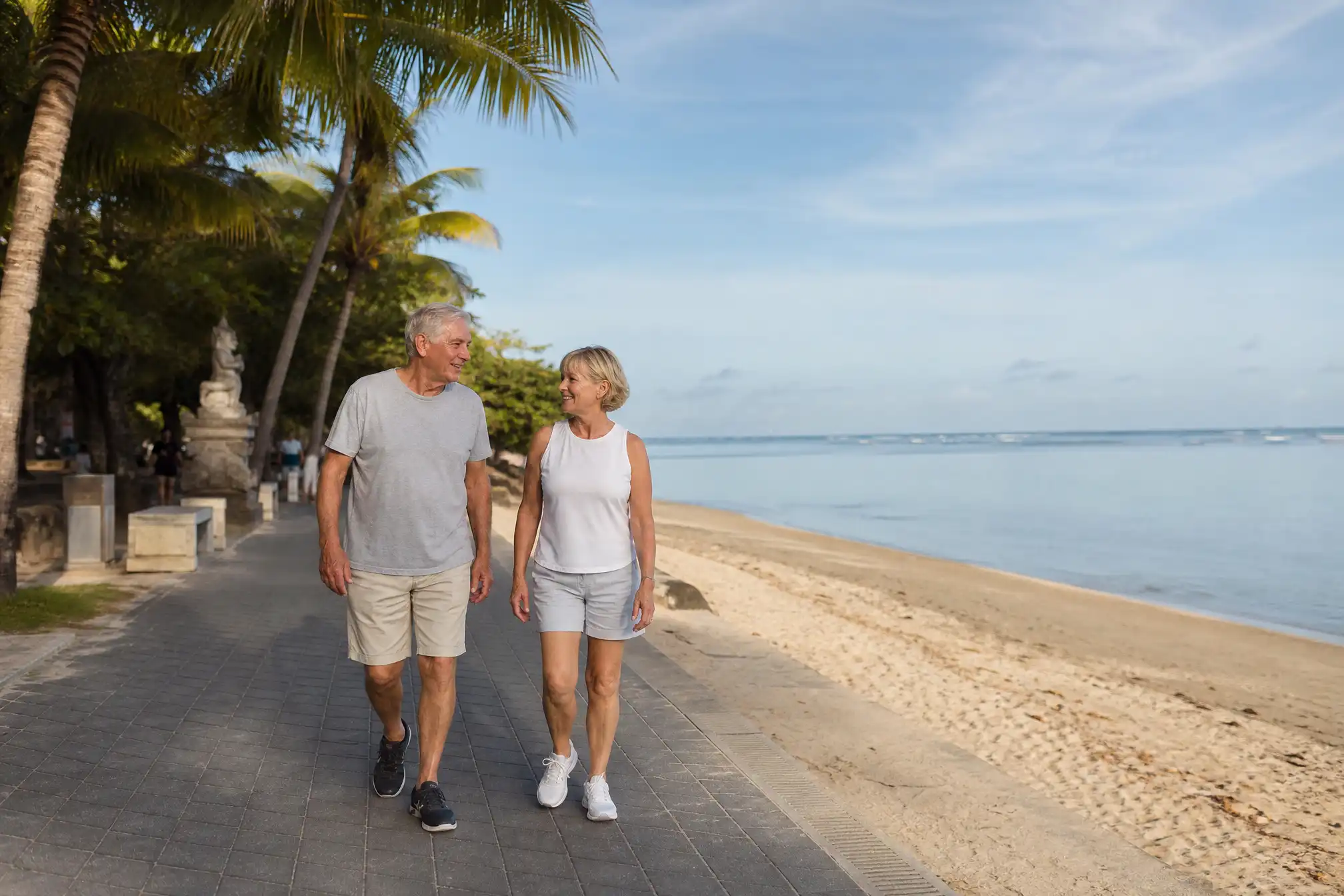
Bali, Lombok, Yogyakarta and the islands all suit different types of retirees. The right choice depends on your priorities.
Discuss where to live| Destination | Best For | Relative Cost | Healthcare Access |
|---|---|---|---|
| South Bali (Seminyak/Canggu) | Full expat lifestyle, best healthcare | Highest in Indonesia | Best on island (BIMC, Siloam) |
| East Bali (Sanur/Nusa Dua) | Quieter residential, community feel | Mid-high | Good (BIMC Nusa Dua) |
| Ubud | Culture, wellness, nature | Mid | Limited (45–60 min to hospital) |
| Lombok | Affordability, authentic Indonesia | Low-mid | Limited (transfer to Bali) |
| Yogyakarta | Cultural depth, Java immersion | Lowest | Limited (specialist in Surabaya) |
| Gili Islands | Pure island life, ocean | Mid (high for basics) | Minimal (evacuation to Lombok/Bali) |
South Bali is where most of Bali's international expat community is concentrated, and for good reason. The infrastructure here is the strongest on the island: the best private hospitals, the widest restaurant and cafe scene, the most reliable internet, and the greatest density of services oriented toward foreign residents. Seminyak and Canggu in particular have evolved into genuinely cosmopolitan neighbourhoods with world-class dining, thriving wellness and yoga scenes, surf beaches, and a social life that requires no effort to access. The trade-off is that this part of Bali is the most expensive, the most crowded in peak season, and the furthest from the spiritual and cultural Bali that many people moved here to experience.
Sanur and Nusa Dua sit on Bali's calmer eastern and southern coastline, sheltered from the swell that makes the west coast popular with surfers. The result is a calmer sea, a gentler pace, and a more residential character that suits retirees who want a genuine community rather than a tourist strip. Sanur in particular has been a long-established expat enclave and has a settled, village-like feel unusual for a Bali beach town. It has a good morning market, reliable cafe scene, flat cycling paths along the beach road, and a social scene built around people who actually live here rather than passing through.
Ubud is not a beach town and makes no pretence of being one. Set among rice terraces and jungle in Bali's inland highlands at around 300 metres elevation, it is the cultural and spiritual centre of the island, home to the finest Balinese art, music, dance, and craft traditions. It is also one of the world's most established wellness destinations, with more yoga studios, meditation centres, healing practitioners, and retreat facilities per square kilometre than almost anywhere on the planet. For retirees drawn to a more contemplative, culturally rich life, Ubud is compelling in a way that no beach town quite matches.
Lombok sits 35 kilometres east of Bali across the Lombok Strait and offers something increasingly rare in this part of the world: a genuinely beautiful island that has not yet been fully discovered. Mount Rinjani, the second-highest volcano in Indonesia, dominates the interior. The south coast beaches are spectacular and largely uncrowded. Lombok is predominantly Muslim rather than Hindu-Balinese, giving it a distinctly different cultural character. The expat community is small but growing, infrastructure is improving faster than at any point in the island's history, and the cost of living is lower than Bali.
Yogyakarta is not a conventional retirement destination and we include it not because it attracts large numbers of foreign retirees, but because for a very specific type of person it is extraordinary. The cultural capital of Java sits near the active Merapi volcano and a short drive from Borobudur, the world's largest Buddhist temple, and Prambanan, a magnificent ninth-century Hindu temple complex. The city itself is a living centre of Javanese arts, batik, silver craft, and wayang puppet theatre. The cost of living is among the lowest of any city in this guide. There is almost no expat retirement community to speak of, which is either a dealbreaker or an appeal depending entirely on who you are.
The three Gili Islands off Lombok's north-west coast, Gili Trawangan, Gili Meno, and Gili Air, are unlike anywhere else in Indonesia. No motorised vehicles of any kind are permitted; transport is by horse cart or bicycle. The islands are small enough to walk around in an hour or less. The water is extraordinary: coral reefs, sea turtles, and visibility that draws divers from around the world. Gili Air is the most settled and most appropriate for long-term living, with a small but committed expat community. Gili Meno is the quietest and most undeveloped of the three. Gili Trawangan has the most developed tourist infrastructure and a party reputation that sits uneasily with serious retirement.
Yes, for the right person. Indonesia suits retirees who want culture, natural beauty, warm weather, lower day-to-day costs, and a slower lifestyle. Bali, Sanur, Ubud and parts of Lombok are the most common starting points.
The trade-off is that Indonesia is not as administratively simple as some other retirement destinations. Visas, property rules, healthcare planning and local bureaucracy need to be handled properly.
You can live long-term in Bali if you qualify for the right retirement visa. The standard pathway is the E33F Retirement KITAS, with the Silver Hair Visa available as a higher-commitment option for older retirees who meet the financial requirements.
After several years on the correct stay permit, some retirees may become eligible for a longer-term KITAP pathway. This should be managed through a reputable Indonesian visa agent.
Foreigners cannot own freehold land in Indonesia. Legal options include leasehold, Hak Pakai for eligible residents, or a PT PMA structure for commercial property or business use.
Nominee arrangements, where an Indonesian citizen holds land on behalf of a foreigner, are dangerous and should be avoided. They are not a safe workaround.
For routine care, dental work, basic specialist consultations and many common medical needs, Bali's private clinics and hospitals are generally adequate and affordable.
For serious cardiac, neurological, cancer, trauma or complex surgical needs, evacuation to Singapore, Australia or another regional medical centre may be required. Medical evacuation cover is essential.
Bali is still far cheaper than most Western cities, but the popular expat areas are no longer as cheap as older guides suggest. Canggu, Seminyak and some parts of Ubud have seen strong rental and restaurant price growth.
Sanur, parts of East Bali, North Bali and Lombok can offer better value, depending on the lifestyle and healthcare access you need.
No. Working on a retirement visa is not permitted and can create serious immigration consequences. This includes local employment, freelance work, paid consulting, operating a villa rental business, or providing services for payment.
If you intend to earn income while in Indonesia, you need proper immigration and tax advice before you arrive.
For most retirees, the shortlist starts with Sanur, Ubud, South Bali and Lombok. Sanur is often the easiest fit for a calmer long-term lifestyle. South Bali has the most services and healthcare access. Ubud is best for culture, wellness and inland living. Lombok offers lower costs and a quieter environment but weaker healthcare infrastructure.
The right choice depends on your health, budget, preferred pace, need for community and tolerance for infrastructure trade-offs.
You can manage in English in the main Bali expat areas, especially in restaurants, clinics, hotels and businesses that deal with foreigners. Outside those areas, English is much less reliable.
Learning basic Bahasa Indonesia makes daily life easier and earns genuine goodwill. It is one of the best investments a long-term resident can make.
The information on this page reflects our best understanding of the rules, costs, and conditions applicable to foreign retirees in Indonesia as of June 2026. Indonesian immigration law, tax regulations, property rules, visa requirements, healthcare conditions, and general living costs change regularly and sometimes with limited advance notice. Cost-of-living figures are sourced from Numbeo city comparison data and are approximate averages based on reported contributor data; individual outcomes vary based on lifestyle, specific location within Indonesia, currency movements, and personal circumstances. Nothing on this page constitutes legal, financial, immigration, tax, or medical advice. Tax obligations vary significantly by nationality; US citizens should seek specific advice regarding FATCA and foreign pension reporting requirements regardless of where they reside. Indonesian property law is complex and the consequences of errors are serious; independent legal advice from a qualified Indonesian property lawyer is essential before entering into any property transaction. We strongly recommend that you independently verify all information relevant to your specific situation, consult a licensed immigration adviser for visa matters, obtain advice from a qualified financial and tax adviser in both your home country and Indonesia before making any decisions, and speak with a qualified medical professional regarding your personal healthcare situation and how it relates to your chosen location. RetireToAsia.com.au accepts no liability for decisions made in reliance on information contained on this page.